
Estimated reading time: 13 minutes
Table of contents
- Rather listen to a podcast about this article rather than read it?
- The Hidden Cost of the Wrong Client Mix
- Understanding True Client Profitability (Not Just Revenue)
- The Four Dimensions of Client Profitability Analysis
- How to Identify Your Unprofitable Clients (The Red Flags)
- The Client Profitability Audit Framework (Step-by-Step)
- What to Do With Your Findings (The Action Plan)
- Common Mistakes Firms Make (And How to Avoid Them)
- Conclusion
Key Takeaways
- Client profitability analysis is crucial for identifying which clients are truly profitable and which are draining resources.
- Firms often overlook true profitability, focusing only on revenue, leading to unprofitable client mixes that hinder growth.
- Four key metrics track client profitability: total revenue, hours invested, realization rate, and payment speed.
- The article outlines a five-step framework for conducting a client profitability audit, including data gathering and tier segmentation.
- Acting on the findings involves restructuring unprofitable clients, optimizing B-tier clients, and nurturing A-tier clients.
Rather listen to a podcast about this article rather than read it?
You have a client that’s been with you for eight years. They pay $60,000 annually. On paper, they look like one of your best clients.
But here’s what you might not realize: they’re also consuming 40% more hours than your average client. They constantly request rush work. Their documentation is disorganized. They pay invoices 60+ days late. And they’ve rejected every attempt to expand services beyond basic tax compliance.
This client isn’t your best. They’re your worst.
According to research from Hinge Research Institute, the average professional services firm has a 30% variance in profitability across its client base. That means some clients are generating 3-4 times the profit of others, even when revenue looks similar. Yet most accounting firm leaders can’t tell you which clients fall into which category.
The problem isn’t that you lack clients or expertise. It’s that you’ve never conducted a proper client profitability analysis. You’re making decisions based on revenue, not profitability. And that’s costing you thousands every month.
In this guide, you’ll learn the exact framework we use to help accounting firms audit their client mix, identify which clients are truly profitable, and make strategic decisions about where to invest your time and resources. No complex formulas. No accounting theory. Just a practical approach you can implement this week.
The Hidden Cost of the Wrong Client Mix
Most accounting firms operate with a fundamental blind spot: they don’t know which clients are actually profitable.
They track revenue. They track hours. But they don’t connect the two to understand true profitability per client. So they end up with a client mix that looks good on the surface but drains profitability beneath the surface.
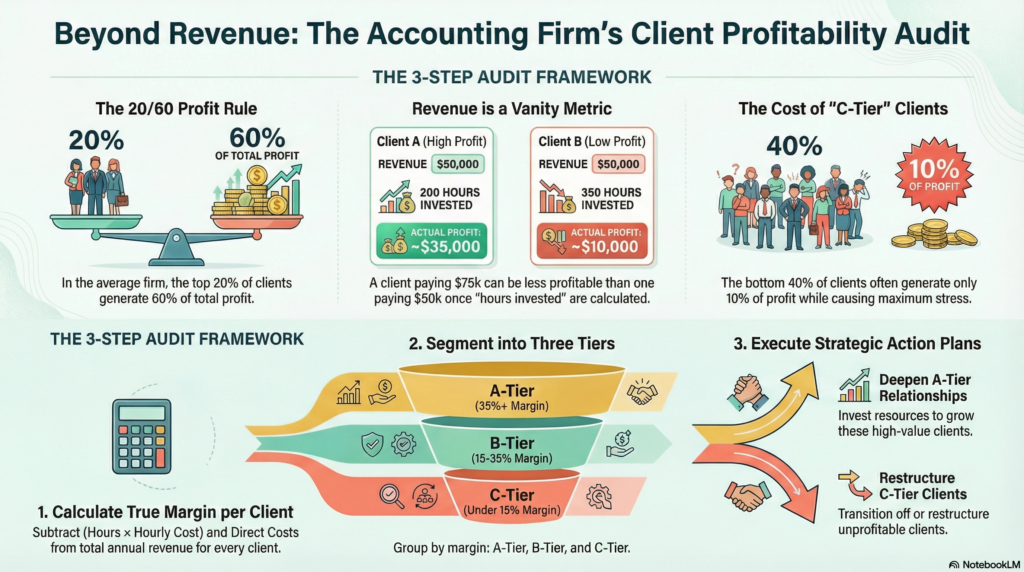
Here’s what this looks like in practice. A firm has 50 clients generating $2 million in annual revenue. The managing partner thinks they’re doing well. But when they finally analyze profitability, they discover:
- 10 clients (20%) generate 60% of profit
- 20 clients (40%) generate 30% of profit
- 20 clients (40%) generate 10% of profit (or are actually unprofitable)
That bottom 40% is consuming resources, creating stress, and limiting growth. Yet most firms keep these clients because they’re afraid of losing revenue.
The fear is understandable but misguided. Losing an unprofitable client isn’t a loss. It’s a gain. It frees up capacity to serve better clients, expand advisory services, and improve firm profitability.
According to the 2025 AICPA Management of an Accounting Practice (MAP) Survey, firms that actively manage their client mix report 18-25% higher profitability than those that don’t. They’re not working harder. They’re working smarter.
The question isn’t whether you can afford to analyze your client profitability. It’s whether you can afford not to.
Understanding True Client Profitability (Not Just Revenue)
Revenue is what a client pays you. Profitability is what’s left after you account for the cost to serve them.
These are not the same thing. But you know this already.
A client paying $50,000 annually might be more profitable than a client paying $75,000, depending on how much time and resources each requires. Yet most firms price and manage clients based on revenue alone.
To understand true profitability, you need to track four key metrics for each client:
1. Total Revenue
What the client pays annually across all services. This is the easy part—you already track this.
2. Hours Invested
The actual time your team spends on this client across all services. This includes direct work, administrative tasks, client communication, and revisions. Most firms underestimate this number significantly.
3. Realization Rate
The percentage of hours you bill that you actually collect payment for. If you bill 100 hours but only collect payment for 85 hours (due to discounts, write-offs, or unbilled work), your realization rate is 85%.
4. Payment Speed
How quickly the client pays invoices. A client paying in 15 days is more profitable than one paying in 60+ days, because you’re not financing their business.
Here’s a concrete example. You have two clients, both paying $50,000 annually:
Client A:
- Revenue: $50,000
- Hours invested: 200 hours
- Realization rate: 95%
- Payment speed: 20 days
- Actual profit: ~$35,000 (after accounting for your $125/hour cost to serve)
Client B:
- Revenue: $50,000
- Hours invested: 350 hours
- Realization rate: 80%
- Payment speed: 60+ days
- Actual profit: ~$10,000 (after accounting for your $125/hour cost to serve)
On paper, they’re identical. In reality, Client A is 3.5 times more profitable than Client B.
This is why client profitability analysis matters. It reveals which clients are truly valuable and which are draining resources. And it shows you exactly where to focus your efforts.
The Four Dimensions of Client Profitability Analysis
Client profitability isn’t one-dimensional. It’s not just about margin. It’s about understanding clients across multiple dimensions so you can make strategic decisions about where to invest.
Here are the four dimensions we evaluate:
Dimension 1: Financial Profitability
This is the most obvious dimension. Calculate the actual profit generated by each client after accounting for:
- Direct labor costs (hours × hourly cost)
- Indirect costs (overhead allocation)
- Realization rate (actual vs. potential billing)
- Payment terms (cost of financing)
A client generating 40% margin is more profitable than one generating 15%, even if revenue is similar.
Dimension 2: Operational Efficiency
Some clients require significantly more effort than others, even for similar services. Evaluate:
- Hours required per service
- Complexity of work
- Frequency of revisions or rework
- Administrative burden (communication, scheduling, follow-up)
A client requiring 50 hours for tax prep is less efficient than one requiring 30 hours, even if they pay the same fee.
Dimension 3: Strategic Fit
Does this client align with your firm’s positioning and growth strategy? Evaluate:
- Alignment with your ideal client profile
- Potential for advisory service expansion
- Industry or business type fit
- Growth potential
A client in your target industry with advisory potential is more valuable than a commodity compliance client, even if current revenue is similar.
Dimension 4: Relationship Quality
How easy is it to work with this client? Evaluate:
- Payment reliability and speed
- Communication style and responsiveness
- Scope creep and boundary issues
- Likelihood of long-term retention
- Referral potential
A client who pays on time, communicates clearly, and respects boundaries is more valuable than one who doesn’t, even if profit margins are similar.
When you evaluate clients across all four dimensions, a clear picture emerges. Some clients score high on all dimensions—these are your A-tier clients. Others score low across the board—these are your C-tier clients. And most fall somewhere in between.
How to Identify Your Unprofitable Clients (The Red Flags)
Before you conduct a full profitability analysis, look for these red flags that typically indicate unprofitable clients:
Red Flag #1: Constant Scope Creep
The client regularly asks for “just one more thing” without additional compensation. What started as a tax return now includes bookkeeping, payroll consultation, and business planning—all at the original price.
Red Flag #2: Slow or Unreliable Payment
The client consistently pays invoices 60+ days late or frequently disputes charges. You’re financing their business, which erodes profitability.
Red Flag #3: High Maintenance
The client requires frequent communication, multiple revisions, or extensive hand-holding. They consume disproportionate time relative to the fee.
Red Flag #4: Misalignment With Your Positioning
The client doesn’t fit your ideal client profile. They’re in an industry you don’t specialize in, or they need services you’re not positioned to deliver well.
Red Flag #5: Low-Margin Services Only
The client only wants basic compliance work (tax prep, bookkeeping) and has rejected every attempt to expand into advisory services. You’re stuck in a commodity relationship.
Red Flag #6: Frequent Discounting Requests
The client regularly negotiates fees down or requests discounts. This signals they don’t perceive value in your work and are price-sensitive.
Red Flag #7: Negative Attitude or Disrespect
The client is dismissive, demanding, or disrespectful to your team. This creates stress and burnout, which has real costs.
If a client has 3+ of these red flags, they’re likely unprofitable or close to it. They’re candidates for restructuring, price increases, or transition off your client list.
The Client Profitability Audit Framework (Step-by-Step)
Here’s the exact five-step framework we use to help firms audit their client profitability:
Step 1: Gather Your Data
You need three pieces of information for each client:
- Annual revenue (total fees paid)
- Hours invested (total time across all services)
- Direct costs (labor, outsourcing, or other direct expenses)
If you use practice management software (like Karbon, Firm360, or similar), you can export this data. If not, you’ll need to estimate based on timesheets and billing records.
Be honest about hours. Most firms underestimate the time they spend on clients because they don’t account for administrative work, revisions, and communication.
Step 2: Calculate Profitability Per Client
Use this simple formula:
Client Profit = Revenue – (Hours × Hourly Cost) – Direct Costs
Your hourly cost is your total operating expenses divided by total billable hours. If your firm spends $500,000 annually on operations and your team logs 4,000 billable hours, your hourly cost is $125.
So if a client generates $50,000 in revenue and requires 300 hours of work:
- Revenue: $50,000
- Cost: 300 hours × $125 = $37,500
- Profit: $50,000 – $37,500 = $12,500
- Profit margin: 25%
Do this for every client. You’ll start to see patterns.
Step 3: Segment Clients Into Tiers
Once you have profitability data, segment your clients into three tiers:
A-Tier Clients (Top 20%)
- Highest profitability (typically 35%+ margin)
- Strong strategic fit
- Positive relationship quality
- Growth potential
B-Tier Clients (Middle 50%)
- Moderate profitability (typically 15-35% margin)
- Mixed strategic fit
- Acceptable relationship quality
- Some growth potential
C-Tier Clients (Bottom 30%)
- Low or negative profitability (typically <15% margin)
- Poor strategic fit
- Challenging relationships
- Limited growth potential
Most firms discover that their top 20% of clients generate 60%+ of profit. Their bottom 30% generate 10% or less.
Step 4: Analyze Patterns and Red Flags
Look for patterns within each tier:
- What characteristics do A-tier clients share?
- What problems are common in C-tier clients?
- Are there industries, service types, or client sizes that correlate with profitability?
- Which red flags appear most frequently in unprofitable clients?
This analysis reveals your ideal client profile and helps you understand what’s working and what isn’t.
Step 5: Develop an Action Plan for Each Tier
For each tier, create a specific action plan:
A-Tier Clients:
- Invest in growth and relationship deepening
- Expand advisory services
- Increase fees strategically
- Prioritize for referrals and case studies
B-Tier Clients:
- Optimize operations to improve efficiency
- Consider service adjustments or pricing changes
- Evaluate potential to move to A-tier
- Set clear boundaries on scope
C-Tier Clients:
- Restructure the relationship (raise prices, reduce scope, or both)
- Transition off your client list
- Or, if strategic fit is strong, invest in moving them to B-tier
This framework takes 4-6 hours to complete for a 50-client firm. It’s one of the highest-ROI activities you can do.
What to Do With Your Findings (The Action Plan)
Conducting the analysis is one thing. Acting on it is another.
Here’s how to handle each tier:
Managing A-Tier Clients
These are your best clients. Treat them accordingly.
Invest in deepening relationships. Schedule regular strategic reviews. Proactively identify opportunities to expand services. Increase fees strategically (most A-tier clients will accept reasonable increases because they perceive value).
Use A-tier clients as case studies and referral sources. Ask them for introductions to similar businesses. Feature them in your marketing (with permission).
The goal: grow these relationships and increase their lifetime value.
Managing B-Tier Clients
B-tier clients are your bread and butter. The goal is to optimize them and move the best ones to A-tier.
Start by identifying which B-tier clients have the potential to move up. These are typically clients with:
- Strong strategic fit
- Positive relationships
- Untapped advisory potential
- Growth trajectory
For these clients, develop a plan to expand services and improve efficiency. Maybe they need better onboarding to reduce administrative burden. Maybe they’re ready for advisory services. Maybe they need a pricing adjustment to reflect true value.
For B-tier clients without upside potential, focus on operational efficiency. Can you streamline their service delivery? Can you set clearer boundaries on scope? Can you automate parts of their work?
Managing C-Tier Clients
This is where most firms struggle. C-tier clients are unprofitable or barely profitable, yet firms keep them out of fear.
You have three options:
Option 1: Restructure the Relationship
Raise prices significantly (15-25%). Reduce scope (eliminate low-margin services). Set clear boundaries on communication and revisions.
Be transparent with the client. Explain that you’re restructuring your service model and their fees are increasing. Most will accept it if you communicate value clearly. Some will leave—and that’s okay.
According to the AICPA, fewer than 8% of clients leave due to reasonable, well-communicated price increases.
Option 2: Transition the Client Off
If restructuring doesn’t work, transition them off your client list. This is uncomfortable, but it’s necessary.
Give them 60-90 days notice. Help them find another firm. Provide transition support. End the relationship professionally.
Yes, you’ll lose revenue short-term. But you’ll free up capacity to serve better clients and improve firm profitability long-term.
Option 3: Invest in Moving Them Up
If the client has strong strategic fit but is unprofitable due to operational inefficiency, invest in improving the relationship.
Maybe they need better onboarding. Maybe they need advisory services to increase revenue. Maybe they need training on how to work with you more efficiently.
This option only makes sense if you believe the client can move to B-tier or A-tier within 12 months.
Common Mistakes Firms Make (And How to Avoid Them)
As you implement client profitability analysis, watch out for these common pitfalls:
Mistake #1: Only Looking at Revenue, Not Profitability
Revenue is vanity. Profit is sanity. A $100,000 client that requires 500 hours of work is less profitable than a $60,000 client that requires 200 hours. Don’t confuse the two.
Mistake #2: Keeping Unprofitable Clients Out of Fear
Fear of losing revenue is the #1 reason firms keep unprofitable clients. But unprofitable clients limit growth, create stress, and prevent you from serving better clients.
The math is simple: if you free up 200 hours by losing an unprofitable client, and you use those hours to serve a profitable client, you increase firm profitability.
Mistake #3: Not Accounting for True Costs
Many firms underestimate the cost to serve a client. They forget to include:
- Administrative time (scheduling, communication, follow-up)
- Revisions and rework
- Overhead allocation
- Cost of financing (slow payment)
Be honest about costs. If you’re not sure, estimate high.
Mistake #4: Making Changes Too Quickly
Don’t overhaul your entire client mix overnight. Start with your most obvious C-tier clients. Restructure or transition them. Then move to the next tier.
Give yourself 12-18 months to optimize your client mix. This allows time for relationships to adjust and for you to fill capacity with better clients.
Mistake #5: Failing to Communicate Changes to Clients
If you’re raising prices or reducing scope, communicate clearly. Explain why. Show value. Give clients time to adjust.
Clients are more accepting of changes when they understand the reasoning and feel respected.
Mistake #6: Not Revisiting the Analysis
Client profitability changes over time. A client that was profitable last year might be unprofitable this year due to scope creep or changing circumstances.
Conduct this analysis annually. Update your client tiers. Adjust your action plan.
Conclusion
Your best clients aren’t necessarily your biggest clients. They’re your most profitable clients—the ones that generate strong margins, align with your positioning, and create positive relationships.
Your worst clients aren’t necessarily your smallest clients. They’re your most unprofitable clients—the ones that consume disproportionate resources, create stress, and limit growth.
The difference between a thriving accounting firm and a struggling one often comes down to client mix. Firms that actively manage their client profitability grow faster, generate higher margins, and experience less burnout.
This isn’t about being ruthless. It’s about being strategic. It’s about understanding which clients deserve your best effort and which ones are holding you back.
Start this week. Pull your client list. Calculate profitability for your top 20 clients. Identify your A-tier, B-tier, and C-tier clients. Then develop an action plan for each tier.
You don’t need perfect data. You need directional accuracy. Even a rough analysis will reveal patterns and opportunities you’re currently missing.
At RightFit Accounting Performance Group, we help firms optimize their client mix and positioning as part of our Strategy Framework. If you’d like a structured approach to analyzing your client profitability and building a growth strategy around it, reach out to our team.
Your firm’s profitability depends on it.