
Estimated reading time: 12 minutes
Rather Listen than read? Listen to our podcast here!
Table of contents
- Rather Listen than read? Listen to our podcast here!
- INTRODUCTION
- THE AI IMPLEMENTATION GAP FOR ACCOUNTING IS REAL (AND IT’S COSTING YOU)
- WHY ACCOUNTING FIRMS FAIL AT AI IMPLEMENTATION (IT’S NOT THE TECHNOLOGY)
- THE HIDDEN COSTS OF FAILED AI IMPLEMENTATION
- THE THREE PILLARS OF SUCCESSFUL AI IMPLEMENTATION
- WHY MOST FIRMS STRUGGLE: THE EXECUTION GAP
- YOUR ACCOUNTING FIRMS AI IMPLEMENTATION ROADMAP: FROM PLANNING TO DELIVERY
- THE RIGHTFIT APPROACH: CLOSING THE IMPLEMENTATION GAP
- GETTING STARTED: YOUR FIRST STEPS THIS WEEK
- CONCLUSION
INTRODUCTION
Your firm just spent $15,000 on new accounting automation software. Three months later, your team is still doing things the old way. The tool sits unused while your staff complains about the learning curve, and you’re wondering if you just threw money away. This is called the AI implementation gap that many accounting firms are struggling to solve.
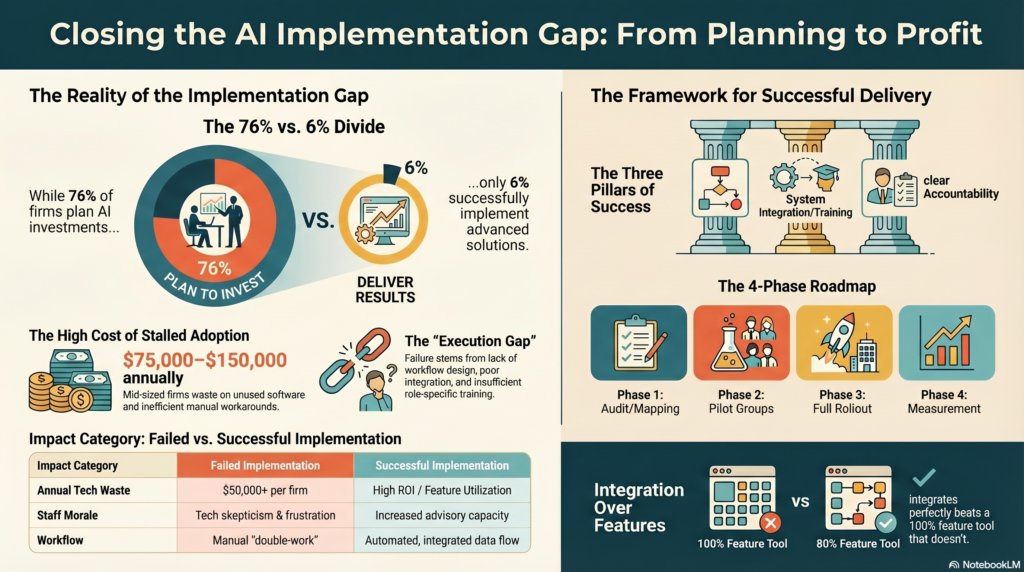
You’re not alone. According to the Savant Labs 2026 Trends Report, as reported by CPA Practice Advisor, 76% of finance and accounting leaders plan to invest in AI and agentic automation this year — yet only 6% have achieved advanced, broad-scale implementation. That’s a massive gap between intention and execution.
The problem isn’t the technology. Modern AI tools are powerful, intuitive, and genuinely useful. The problem is that most accounting firms treat AI implementation like a one-time purchase instead of a strategic process. They buy the tool, expect their team to figure it out, and wonder why adoption stalls.
In this guide, you’ll learn why this gap exists, what it’s costing your firm, and exactly how to close it. By the end, you’ll have a clear roadmap for implementing AI and automation in a way that actually sticks.
THE AI IMPLEMENTATION GAP FOR ACCOUNTING IS REAL (AND IT’S COSTING YOU)
Let’s start with the numbers. Seventy-six percent of accounting firms are planning AI investments. That’s three out of four firms recognizing that automation is essential to staying competitive.
But here’s where it gets sobering: only 6% of those firms have successfully implemented advanced AI solutions. That means 70% of firms are either still in the planning phase, have started but stalled, or have given up entirely.
What does this gap look like in practice? A firm invests $20,000 in software licenses, $5,000 in initial training, and countless hours of staff time trying to integrate a new tool. Six months later, adoption is at 30%. The tool handles maybe one workflow while everything else still runs on spreadsheets and manual processes.
The financial impact is staggering. According to Intuit data cited in Accounting Today, businesses waste an average of $36,000 per year on apps they rarely or never use — and for accounting firms juggling an ever-growing tech stack, that number is likely higher.
That’s money that could go toward hiring, client service, or partner compensation. Instead, it’s sitting in unused features and abandoned implementations.
But the real cost goes deeper than wasted software fees. Failed implementations create frustration among your team. They lose confidence in technology initiatives. When you announce the next tool or system, they’re skeptical. And that skepticism becomes a barrier to future improvements.
Accounting firms that are successfully implementing AI aren’t smarter or better funded than yours. They’re just approaching it differently. They understand that buying a tool is only 10% of the work. The other 90% is execution.
WHY ACCOUNTING FIRMS FAIL AT AI IMPLEMENTATION (IT’S NOT THE TECHNOLOGY)
Here’s what most firms get wrong: they assume the tool will solve the problem. They think, “If we just get the right software, everything will improve.”
That’s backwards. The tool is only as good as the process it supports. If your workflow is broken, a fancy AI tool won’t fix it. It’ll just automate the broken process faster.
Let’s look at the most common failure points:
Failure Point 1: No Workflow Design Before Implementation
Most accounting firms buy a tool first, then try to figure out how to use it. This is like buying a house before deciding where you want to live.
The right approach is the opposite. Before you buy anything, map out your ideal workflow. What steps does this process need? Who’s responsible for each step? Where are the bottlenecks? Only after you have clarity on the workflow should you select a tool that supports it.
Accounting firms that skip this step end up forcing their workflows to fit the tool instead of finding a tool that fits their workflows. The result is clunky, inefficient processes that nobody wants to use.
Failure Point 2: Insufficient Training and Change Management
You roll out new software on a Monday morning. Your team gets a 30-minute demo. By Wednesday, they’re frustrated because they don’t understand how to use it for their specific job.
Training isn’t a one-time event. It’s an ongoing process. Different team members need different training. Your senior accountant needs to understand the big picture. Your junior staff member needs step-by-step instructions for their specific tasks. Your partner needs to know how to monitor adoption and results.
Without proper training tailored to different roles, adoption fails. People revert to what they know because it’s faster and less frustrating than struggling with a new tool.
Failure Point 3: Poor Integration with Existing Systems
You implement a new AI tool for document processing. But it doesn’t integrate with your accounting software. So someone still has to manually transfer data from the AI tool to your main system.
You’ve just added a step instead of removing one. No wonder adoption is low.
Successful implementations require tools that work together. Your document processing tool should feed directly into your accounting software. Your time tracking should integrate with your billing system. Your client portal should sync with your CRM.
When tools are siloed, you create extra work. When they’re integrated, you create efficiency.
Failure Point 4: No Clear Accountability or Measurement
You implement a new tool but don’t assign anyone to oversee adoption. There’s no one tracking whether people are actually using it. There’s no measurement of whether it’s delivering the promised benefits.
Without accountability, adoption drifts. People use the tool when they remember, revert to old methods when they’re busy. The tool never reaches critical mass adoption.
Successful implementations have a clear owner. Someone is responsible for training, troubleshooting, and tracking adoption metrics. Someone is measuring whether the tool is delivering promised results.
THE HIDDEN COSTS OF FAILED AI IMPLEMENTATION
When an accounting firm fails to implement AI properly, the costs extend far beyond the software license.
Direct Financial Costs
You’re paying for software you’re not using. You’re paying for training that didn’t stick. You’re paying consultants to help with implementation that stalls. You’re paying staff time to learn tools they’ll abandon.
For a mid-sized firm, this can easily add up to $75,000 to $150,000 annually in wasted technology spending.
Operational Costs
Failed implementations disrupt your workflows. Your team is confused about which system to use. Processes take longer because people are working around the new tool instead of with it. Errors increase because people are using workarounds instead of the designed process.
One firm we worked with implemented a new client onboarding tool but didn’t integrate it with their existing systems. For six months, their onboarding process was slower and more error-prone than before. They were doing double work: entering data into the new tool and then re-entering it into their main system.
Opportunity Costs
While your firm is struggling with failed implementations, your competitors are moving forward. They’re automating routine work, freeing up their team to focus on advisory services. They’re closing month-end faster. They’re handling more clients with the same staff.
The gap widens. They pull ahead. And your firm is still trying to figure out why the last tool didn’t work.
Team Morale Costs
Failed implementations damage team morale. Your staff loses confidence in technology initiatives. When you announce the next improvement, they’re skeptical. They’ve been burned before.
This skepticism becomes a barrier to future improvements. Even when you implement something genuinely useful, adoption is slower because people don’t trust it will actually work.
THE THREE PILLARS OF SUCCESSFUL AI IMPLEMENTATION
Accounting firms that successfully implement AI and automation share a common approach. They focus on three pillars:
Pillar 1: Workflow Design
Before buying any tool, design your ideal workflow. Map out every step. Identify bottlenecks. Determine where automation can add value.
This isn’t theoretical. It’s specific to your firm. Your workflow might be different from another firm’s workflow. Your bottlenecks might be different. Your automation opportunities might be different.
Spend time on this. Interview your team. Observe how work actually flows (not how you think it flows). Document the current state. Then design the ideal future state.
Only after you have this clarity should you select tools.
Pillar 2: Integration and Training
Select tools that integrate with your existing systems. Then invest in proper training.
Training should be role-specific. Your partner needs different training than your junior staff. Your senior accountant needs different training than your bookkeeper.
Training should be ongoing. One training session isn’t enough. People need reinforcement. They need access to resources when they get stuck. They need to see how the tool applies to their specific job.
Pillar 3: Change Management and Accountability
Assign someone to own the implementation. This person is responsible for training, troubleshooting, tracking adoption, and measuring results.
Set clear expectations. Define what success looks like. Measure adoption rates. Track whether the tool is delivering promised benefits.
When people know someone is paying attention, adoption improves. When they see results, they become advocates instead of skeptics.
WHY MOST FIRMS STRUGGLE: THE EXECUTION GAP
Here’s the uncomfortable truth: most accounting firms are good at strategy but terrible at execution.
You can hire a consultant to tell you that you need to automate your client onboarding process. That’s strategy. But actually designing the workflow, selecting the right tool, integrating it with your systems, training your team, and measuring adoption? That’s execution. And that’s where most firms fall apart.
Why? Because execution is hard. It requires sustained focus. It requires someone to own it. It requires discipline to see it through when other urgent issues come up.
Most firms don’t have the internal resources to handle this. Their partners are busy serving clients. Their operations person is already overwhelmed. So the implementation gets deprioritized. It stalls. Eventually, it fails.
This is where the gap between planning and delivery comes from. Firms have good intentions. They understand they need to automate. But they lack the execution capability to actually make it happen.
YOUR ACCOUNTING FIRMS AI IMPLEMENTATION ROADMAP: FROM PLANNING TO DELIVERY
Here’s the exact process to close the implementation gap at your firm:
Step 1: Audit Your Current Tools and Usage
Before you buy anything new, understand what you already have.
Create a spreadsheet of every software tool your firm uses. For each tool, document:
- What it’s supposed to do
- How much you’re paying for it
- What percentage of available features you’re actually using
- Who’s responsible for using it
- Whether it’s delivering value
This audit often reveals that you’re already paying for tools you’re not using. You might have features in your accounting software that could eliminate the need for a separate tool. You might have tools that overlap in functionality.
Start by maximizing what you already have before buying something new.
Step 2: Map Your Ideal Workflows
Identify your top three processes that consume the most time or create the most errors. For each process, map out the ideal workflow.
Interview your team. Ask them where they get stuck. Where do they spend the most time? Where do errors happen? What would make their job easier?
Document the current state. Then design the ideal future state. Where could automation add value? Where could integration eliminate manual steps?
Step 3: Select Tools That Integrate
Now that you know what you need, select tools that work together.
Don’t just look at individual tool features. Look at how tools integrate. Can your document processing tool feed directly into your accounting software? Can your time tracking integrate with your billing system?
Integration is more important than individual tool features. A tool with 80% of the features you need but perfect integration is better than a tool with 100% of the features but poor integration.
Step 4: Create an Implementation Timeline
Don’t try to implement everything at once. Create a phased approach.
- Phase 1 (Month 1-2): Workflow design, tool selection, initial setup
- Phase 2 (Month 2-3): Team training, pilot with small group
- Phase 3 (Month 3-4): Full rollout, ongoing support
- Phase 4 (Month 4+): Measurement, optimization, expansion
Assign clear milestones. Assign clear owners. Build in time for troubleshooting and refinement.
Step 5: Assign Accountability and Measure Adoption
Assign someone to own the implementation. This person is responsible for:
- Training and onboarding
- Troubleshooting and support
- Tracking adoption metrics
- Measuring results
- Communicating progress
Define what success looks like. Are you measuring time saved? Error reduction? Client satisfaction? Revenue impact?
Track adoption rates. How many team members are using the tool? How frequently? Are they using it correctly?
Measure results. Is the tool delivering the promised benefits? If not, why not? What needs to change?
THE RIGHTFIT APPROACH: CLOSING THE IMPLEMENTATION GAP
Here’s what we’ve learned from working with dozens of accounting firms: the firms that successfully implement AI and automation aren’t the ones with the biggest budgets. They’re the ones with clear execution.
They understand that buying a tool is only the beginning. They invest in workflow design. They invest in training. They assign clear accountability. They measure results.
This is exactly what RightFit’s Automation Framework does. We don’t just recommend tools. We help you design workflows, select tools that integrate, train your team, and measure adoption.
We’ve seen firms go from 30% adoption to 85% adoption in four months. We’ve seen firms save 15+ hours per week through proper automation. We’ve seen firms increase revenue without increasing headcount because they’re working smarter, not harder.
The difference isn’t the tools. It’s the execution.
GETTING STARTED: YOUR FIRST STEPS THIS WEEK
You don’t need to overhaul your entire technology stack. Start small.
This week:
- Audit one process. Pick your most time-consuming process. Map out how it currently works. Identify where automation could help.
- Interview your team. Ask them what’s frustrating about their current tools. What would make their job easier? What are they doing manually that could be automated?
- Research integration options. Look at your current tools. Are there integrations you’re not using? Could you eliminate a tool by using features in your existing software?
- Identify your implementation owner. Who on your team will own this initiative? Who will be responsible for training, troubleshooting, and measuring adoption?
Next month:
Design your ideal workflow for that one process. Select a tool that integrates with your existing systems. Create a training plan. Pilot with a small group.
Measure results. Did it work? Did it save time? Did it reduce errors? Did your team adopt it?
If it worked, expand to the next process. If it didn’t, figure out why and adjust.
This methodical approach takes longer than buying a tool and hoping it works. But it actually works. And that’s what matters.
CONCLUSION
The gap between planning and delivery is the real problem in accounting firm AI implementation. Seventy-six percent of firms plan to invest in automation. Only 6% actually deliver results.
The difference isn’t intelligence or resources. It’s execution. Firms that succeed are the ones that invest in workflow design, proper training, integration, and accountability.
You don’t need another AI tool. You need someone to make it work for your firm.
Start with the roadmap above. Audit your current tools. Map your ideal workflows. Select tools that integrate. Assign clear accountability. Measure results.
If you’d like a structured approach to implementing AI and automation at your firm, RightFit can help. Our Automation Framework is specifically designed to close the implementation gap and deliver real results.
Ready to move from planning to delivery? Schedule a discovery call with our team to discuss your automation opportunities.