
Estimated reading time: 22 minutes
Want to listen to a podcast instead of read?
Table of contents
- Want to listen to a podcast instead of read?
- Introduction
- Part 1: Defining Your Audience and Finding Your Niche
- Part 2: Crafting Language That Resonates
- Part 3: Getting Your Message to Your Audience
- Part 4: Growing Revenue with Your Current Clients
- Part 5: Automating Routine Tasks and Scaling Your Firm
- Conclusion: Putting It All Together
Introduction
Let’s be honest: the accounting industry isn’t what it used to be. Remember when a solid reputation and a few well-placed referrals were enough to keep your firm’s pipeline full? Those days are about as outdated as paper ledgers and fax machines. You need to have a marketing strategy for your accounting firm.
Today’s competitive landscape demands something different, something more strategic. While traditional word-of-mouth referrals and long-standing client relationships still matter (and always will), they’re no longer sufficient on their own. Managing partners who fail to implement a cohesive marketing strategy risk losing market share to more digitally savvy competitors who understand how modern buyers search for and evaluate professional services.
Here’s the thing though: marketing doesn’t have to be complicated or overwhelming. You don’t need a massive budget or a full-time marketing team to get started. What you need is a clear strategy that aligns with how your firm actually operates and serves clients.
This comprehensive guide walks you through the essential components of building a marketing strategy for your accounting firm that drives sustainable growth. Whether you’re a small practice or a mid-sized firm, the principles outlined here will help you attract qualified leads, retain valuable clients, and position your firm as a trusted advisor in your market. Think of it as your roadmap to marketing success, minus the accounting puns (well, mostly).
Part 1: Defining Your Audience and Finding Your Niche
The Foundation: Understanding Your Ideal Client
Before you invest a single dollar in marketing, you must clearly define who you want to serve. Many accounting firms make the critical mistake of trying to be everything to everyone. This approach dilutes your message, spreads your resources thin, and makes it nearly impossible to stand out in a crowded marketplace.
Instead, successful firms focus on niche specialization. A niche is a specific segment of the market where you can deliver exceptional value and establish genuine expertise. Rather than positioning yourself as a general accounting firm, you might specialize in serving startups, nonprofits, healthcare practices, real estate investors, or small manufacturing businesses.
Think about it this way: would you rather be known as “an accounting firm” or as “the go-to accounting firm for rapidly scaling SaaS startups”? The second option immediately tells potential clients whether you’re the right fit for them.
Developing Client Personas
Start by creating detailed client personas. A client persona is a semi-fictional representation of your ideal client based on market research and real data about your existing customers. Your persona should include:
Demographic Information: Age range, business size, industry, location, and revenue level
Business Challenges: What keeps your ideal client awake at night? Are they struggling with cash flow management, tax planning, regulatory compliance, or growth planning?
Goals and Aspirations: What does success look like for your ideal client? Are they trying to scale their business, prepare for an exit, or optimize their tax position?
Buying Behavior: How do they search for accounting services? Do they rely on referrals, online research, or industry recommendations?
Pain Points: What frustrates them about their current accounting situation? Are they dealing with outdated systems, poor communication, or lack of strategic guidance?
Don’t just guess at these answers. Talk to your best existing clients. Ask them what challenges they faced before working with you, what they value most about your service, and how they found you in the first place. These conversations will reveal patterns that inform your personas.
Conducting Industry Research
Once you’ve developed initial personas, validate them through industry research. Look at industry associations, trade publications, and online communities where your ideal clients gather. What are they discussing? What problems are they trying to solve? What language do they use to describe their challenges?
This research serves two critical purposes. First, it confirms whether your niche assumptions are accurate. Second, it provides you with the language and terminology your ideal clients use, which you’ll incorporate into your marketing messaging.
For example, if you’re targeting e-commerce businesses, you’ll discover they talk about “COGS optimization,” “marketplace fees,” and “inventory turns,” not generic accounting jargon. Speaking their language immediately establishes credibility.
Selecting Your Niche
Choose a niche where you can genuinely deliver superior value. Consider these factors:
Your Expertise: What industries or business types do you already understand well? What services do you excel at delivering? Start with what you know.
Market Size: Is the niche large enough to support your firm’s growth goals? A niche that’s too small may limit your revenue potential. Do the math before committing.
Competition: How saturated is the niche? Can you differentiate yourself effectively? Sometimes a crowded niche signals strong demand, but you need a clear angle.
Profitability: Are clients in this niche typically profitable? Some niches may have high volume but low margins. Focus on quality over quantity.
Passion: Do you and your team genuinely enjoy working with this type of client? Passion translates into better service and more authentic marketing. If you dread working with a particular client type, don’t make them your niche.
Do you want to dig in more into Business Development for your accounting firm? Read our Biz Dev guide here.
Part 2: Crafting Language That Resonates
Moving Beyond Generic Messaging
Most accounting firms use similar language in their marketing materials. They talk about “comprehensive accounting services,” “experienced professionals,” and “personalized attention.” These phrases are so generic that they fail to differentiate your firm or resonate with your target audience. The next step in your accounting firms marketing strategy is to focus your messaging.
Your ideal clients don’t care that you’re experienced. They care about solving their specific problems. They want to know that you understand their industry, their challenges, and their goals. They want to feel that you’re speaking directly to them, not to a broad, undefined audience.
Here’s a contrarian view: maybe your firm shouldn’t try to sound “professional” in the traditional sense. Maybe what your clients actually want is someone who talks like a real human being, who understands their frustrations, and who can explain complex concepts in plain English. Revolutionary, right?
Understanding Your Client’s Language
The language your ideal clients use to describe their problems is different from the language accountants use. For example, a startup founder might talk about “managing cash burn” or “understanding unit economics,” while an accountant might discuss “cash flow analysis” or “profitability metrics.”
When you use your client’s language, you immediately establish credibility and relevance. You signal that you understand their world, not just accounting principles.
Pay attention to the exact words and phrases your clients use during discovery calls and meetings. Write them down. These are gold for your marketing copy.
Developing Your Unique Value Proposition
Your unique value proposition (UVP) is a clear statement of the tangible results your firm delivers to your ideal clients. It’s not about what you do, but about what your clients achieve by working with you.
For example, instead of saying “We provide tax planning services,” you might say “We help real estate investors reduce their tax liability by an average of 15% while positioning their portfolio for long-term growth.”
Your UVP should:
Be Specific: Avoid vague claims. Use concrete numbers and outcomes when possible. “We save clients money” is weak. “We’ve helped 47 e-commerce businesses reduce their effective tax rate by an average of 12%” is powerful.
Address a Real Problem: Your UVP should solve a problem your ideal client actually has, not one you think they should have.
Be Believable: Make claims you can back up with case studies, testimonials, or data. Outrageous claims without proof damage credibility.
Be Memorable: Your UVP should be concise enough that your team can articulate it consistently across all marketing channels. If your team can’t remember it, your clients certainly won’t.
Creating Messaging Frameworks
Develop messaging frameworks that you use consistently across all marketing channels. These frameworks should include:
The Problem Statement: A clear articulation of the challenge your ideal client faces
The Consequence: What happens if the client doesn’t address this problem? Make it real and specific.
Your Solution: How your firm specifically addresses this problem
The Benefit: What the client achieves by working with you
Social Proof: Evidence that your solution works (testimonials, case studies, data)
For example: “Many startup founders struggle with understanding their financial metrics, which leads to poor business decisions and cash flow crises. At [Your Firm], we help startup founders build financial literacy and implement systems that give them real-time visibility into their business performance. Our clients report making better strategic decisions and extending their runway by an average of 6 months.”
Notice how this framework tells a story? It acknowledges the problem, explains the consequence, presents your firm as a guide, shares a plan, and provides proof. That’s the formula.
Part 3: Getting Your Message to Your Audience
Building Your Digital Foundation
Your website is your digital front door. It’s often the first impression potential clients have of your firm, and it plays a critical role in your overall marketing strategy. Firms with optimized websites see significantly higher conversion rates than those with outdated or generic sites. Your accounting firms marketing strategy needs to actually be implemented on your website.
Website Design and User Experience: Your website should be professional, easy to navigate, and mobile-friendly. Potential clients should be able to quickly understand what you do, who you serve, and how to contact you. If visitors can’t figure out what you do within 5 seconds, you’ve already lost them.
Clear Calls-to-Action: Every page should guide visitors toward a specific action, whether that’s scheduling a consultation, downloading a resource, or signing up for your newsletter. Don’t make people hunt for the next step.
Industry-Specific Landing Pages: Create dedicated landing pages for each niche you serve. These pages should speak directly to that niche’s challenges and demonstrate your expertise in serving that specific market. Generic pages convert poorly.
Trust Signals: Include client testimonials, case studies, credentials, and certifications that build credibility with potential clients. Social proof matters more than ever in 2026.
Search Engine Optimization (SEO)
SEO is the practice of optimizing your website and content so that search engines rank it highly for relevant keywords. When potential clients search for accounting services related to your niche, you want your firm to appear at the top of the search results. Research shows that the top three Google results capture over 54% of all clicks, so ranking matters.
Keyword Research: Identify the keywords and phrases your ideal clients use when searching for accounting services. Tools like Google Keyword Planner, SEMrush, and Ahrefs can help you understand search volume and competition for specific keywords.
On-Page Optimization: Incorporate your target keywords naturally into your website content, including page titles, headings, meta descriptions, and body text. However, never sacrifice readability or user experience for keyword optimization. Google’s algorithms are sophisticated enough to detect keyword stuffing, and they’ll penalize you for it.
Technical SEO: Ensure your website loads quickly, is mobile-friendly, has a clear site structure, and includes proper schema markup. These technical factors influence how search engines rank your site. If your site takes more than three seconds to load, you’re losing potential clients.
Local SEO: If you serve clients in specific geographic areas, optimize your Google Business Profile with accurate information, photos, and regular updates. Encourage satisfied clients to leave reviews, as these significantly influence local search rankings. Local SEO is particularly powerful for accounting firms since many clients prefer working with local professionals.
Content Marketing: Regularly publish high-quality blog posts, guides, and resources that address your ideal client’s questions and challenges. This content attracts organic traffic, establishes your expertise, and provides material you can share across other marketing channels.
Content Marketing Strategy
Content marketing is one of the most effective ways to attract qualified leads and establish your firm as a thought leader in your niche. The key is consistency and relevance. Your accounting firms marketing strategy must include consistent content that proves your authority not only to Google but to prospective clients.
Blog Posts: Write regular blog posts that address specific questions and challenges your ideal clients face. Topics might include “5 Tax Deductions Startups Commonly Miss,” “How to Prepare Your Nonprofit for an Audit,” or “Cash Flow Management Strategies for Seasonal Businesses.” Focus on answering real questions, not showing off your technical knowledge. Check out our Automation Framework to learn more about our automated blog writing tools.
Downloadable Resources: Create valuable resources like checklists, templates, guides, and worksheets that address your clients’ pain points. Offer these resources in exchange for email addresses, building your email list. A well-crafted lead magnet can generate qualified leads for years.
Case Studies: Document how you’ve helped specific clients achieve their goals. Case studies provide concrete evidence of your value and help potential clients envision working with your firm. Numbers and specifics make case studies compelling.
Videos: Create short videos that explain complex accounting concepts, introduce your team, or showcase your firm’s culture. Video content is highly engaging and shareable. You don’t need expensive equipment, just authenticity and useful information.
Webinars and Workshops: Host educational webinars or in-person workshops on topics relevant to your niche. These events position you as an expert and provide opportunities to connect with potential clients. Plus, they give you content you can repurpose for months.
Email Marketing
Email marketing remains one of the highest-ROI marketing channels for professional services firms. Build your email list through your website, content offers, and events, then nurture these relationships with regular, valuable communication. Any accounting firm marketing strategy that doesn’t include email is leaving revenue on the table.
Newsletter Strategy: Send a monthly newsletter with industry insights, tax tips, regulatory updates, and firm news. Keep your newsletter focused on providing value, not just promoting your services. The 80/20 rule applies here: 80% valuable content, 20% promotion.
Segmentation: Segment your email list based on client type, industry, or interests. Send targeted messages to specific segments rather than one-size-fits-all emails. A startup founder doesn’t care about nonprofit compliance issues, so don’t send them that content.
Personalization: Use your email marketing platform to personalize messages with the recipient’s name and relevant information. Personalized emails have significantly higher open and click-through rates. Basic personalization is table stakes in 2026.
Lead Nurturing: Create automated email sequences that nurture prospects through your sales funnel. For example, when someone downloads a resource, they might receive a series of emails providing additional value and gradually introducing your services.
LinkedIn and Social Media
LinkedIn is particularly valuable for B2B professional services, like accounting. It’s where business decision-makers spend time, and it’s an excellent platform for establishing thought leadership.
LinkedIn Profile Optimization: Ensure your firm’s LinkedIn page is complete and professional. Include a clear description of your services, links to your website, and regular updates. Your personal profile matters too, managing partners.
Content Sharing: Share valuable content on LinkedIn, including blog posts, industry insights, and firm news. LinkedIn’s algorithm favors content that generates engagement, so focus on creating posts that spark conversation. Ask questions, share contrarian views, and be willing to take a stand on industry issues.
LinkedIn Ads: Use LinkedIn’s advertising platform to target specific industries, job titles, company sizes, and other criteria. LinkedIn ads are particularly effective for reaching decision-makers in your target niche, though they’re more expensive than other platforms.
Employee Advocacy: Encourage your team members to share firm content and insights on their personal LinkedIn profiles. Employee-shared content typically generates more engagement than company-shared content. People trust people more than they trust brands.
Networking: Use LinkedIn to identify and connect with potential clients and referral sources. Personalize your connection requests and engage with their content before reaching out. Cold connection requests with immediate sales pitches are the fastest way to get ignored.
Paid Advertising
While organic marketing channels are important, paid advertising can accelerate your results, especially when you’re first establishing your presence in a new niche. Paid ads are not a requirement for your accounting firms marketing strategy, but they can help improve your firm’s visibility to new clients.
Google Ads: Run search ads targeting keywords related to your services. For example, if you specialize in serving startups, you might bid on keywords like “startup accountant” or “CPA for startups.” Start with exact match keywords to control costs.
LinkedIn Ads: As mentioned above, LinkedIn ads are excellent for reaching specific professional audiences. The targeting capabilities are unmatched for B2B marketing.
Retargeting: Use retargeting ads to stay in front of people who have visited your website but haven’t yet contacted you. Retargeting is often more cost-effective than acquiring new leads because these people already know who you are.
Budget Allocation: Start with a modest budget and test different channels and messages. Track your results carefully and allocate more budget to the channels and messages that generate the best ROI. Don’t fall into the trap of spreading your budget too thin across too many channels.
Part 4: Growing Revenue with Your Current Clients
The Economics of Client Retention
Here’s something most managing partners don’t want to hear: you’re probably leaving money on the table with your existing clients. Acquiring a new client costs significantly more than retaining an existing client. Research shows that acquiring a new customer can cost 5 to 25 times more than retaining an existing one. This means that growing revenue with your current clients is often more profitable than acquiring new clients.
Additionally, long-term clients typically become more profitable over time. As they understand your value and trust your recommendations, they’re more likely to engage additional services, refer other clients, and provide testimonials. Yet many firms focus almost exclusively on new client acquisition while neglecting their existing client base. A solid marketing strategy for your accounting firm will include consistent communication from your firm to your current clients.
Delivering Exceptional Service
The foundation of client retention is delivering exceptional service. This means:
Responsiveness: Return client calls and emails promptly. Clients should never feel ignored or deprioritized. In 2026, “promptly” means within a few hours, not a few days.
Proactive Communication: Don’t wait for clients to ask questions. Reach out proactively with tax planning ideas, regulatory updates, or strategic recommendations. The firms that thrive are the ones that anticipate client needs.
Expertise: Stay current with tax law changes, accounting standards, and industry trends. Your clients expect you to be the expert. If you’re not continuously learning, you’re falling behind.
Personalization: Understand each client’s unique situation, goals, and preferences. Tailor your service delivery accordingly. Some clients want detailed explanations, others want the bottom line. Adapt your communication style.
Reliability: Deliver on your commitments. Meet deadlines, provide accurate work, and follow through on promises. This should be obvious, but it’s where many firms fail.
Identifying Opportunities for Additional Services
Many accounting firms leave significant revenue on the table by not offering additional services to existing clients. Conduct a service audit to identify gaps:
What services do your clients currently use? Review your client files to understand which services each client engages. You might be surprised by how many clients only use one or two services.
What services could benefit each client? Based on their business type and situation, what additional services could you provide? Think about their entire financial lifecycle.
What services do your competitors offer? Research what other firms in your space are offering to similar clients. Don’t copy them, but understand the market.
What services does your team have capacity to deliver? Consider your team’s expertise and capacity before expanding your service offerings. Don’t overpromise and underdeliver.
Common additional services for accounting firms include:
Tax Planning: Proactive tax planning that goes beyond tax preparation. This is often the highest-value service you can offer.
Bookkeeping and Accounting: If you currently only do tax work, offering bookkeeping services provides ongoing revenue and deeper client relationships.
Payroll Services: Many clients need payroll processing and compliance support. This creates recurring revenue.
Business Consulting: Strategic advice on pricing, profitability, growth, and operations. This is where you transition from vendor to trusted advisor.
Financial Planning: Personal financial planning for business owners. Many business owners struggle to separate business and personal finances.
Audit and Assurance: For clients that need or want audited financial statements, particularly those seeking financing or preparing for a sale.
Building Deeper Client Relationships
Deepen your relationships with existing clients through:
Regular Check-ins: Schedule quarterly or semi-annual meetings with key clients to discuss their business, goals, and any challenges they’re facing. Don’t wait for tax season to talk to your clients.
Industry Insights: Share relevant industry news, trends, and insights with your clients. Position yourself as a trusted advisor, not just a service provider. Curate information they won’t find on their own.
Networking Introductions: Introduce clients to other professionals who might help their business, such as business attorneys, insurance brokers, or commercial lenders. Building your referral network benefits everyone.
Educational Events: Host workshops or webinars on topics relevant to your clients. These events provide value and strengthen relationships. They also give you content for your marketing.
Client Appreciation: Periodically show appreciation for your clients through small gestures like holiday gifts, lunch meetings, or exclusive events. Don’t underestimate the power of genuine gratitude.
Implementing Client Feedback Systems
Regularly gather feedback from your clients to understand their satisfaction and identify areas for improvement. Most firms assume they know what clients think, but assumptions are dangerous.
Surveys: Send periodic surveys asking clients about their satisfaction with your service, communication, and expertise. Keep surveys short and focused.
Net Promoter Score (NPS): Ask clients how likely they are to recommend your firm to others. This single question is a powerful predictor of client retention and growth. Track your NPS over time.
One-on-One Conversations: Have regular conversations with key clients about their satisfaction and needs. Sometimes the most valuable feedback comes from informal conversations.
Feedback Implementation: When you receive feedback, act on it. Clients appreciate knowing that their input leads to improvements. Close the loop by telling clients what you changed based on their feedback.
Part 5: Automating Routine Tasks and Scaling Your Firm
The Importance of Automation
As your firm grows, your team can easily become bogged down with routine, administrative tasks. These tasks consume time that could be spent on higher-value advisory work, client relationship building, and business development.
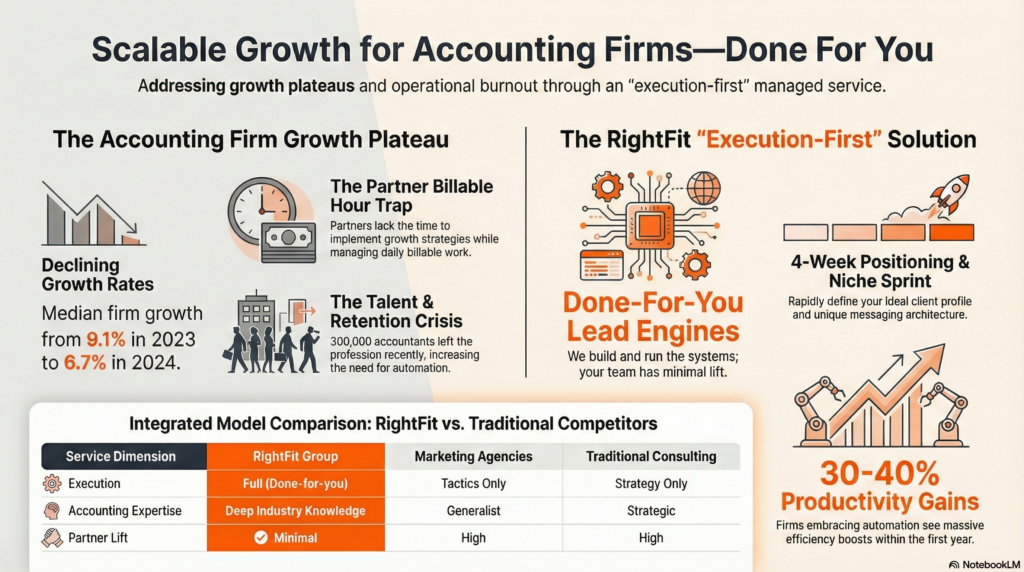
Automation is the key to scaling your firm without proportionally increasing your headcount. By automating routine tasks, you free up your team to focus on the work that generates the most value for clients and the most revenue for your firm. Recent industry research shows that firms that embrace automation see productivity gains of 30-40% within the first year.
Here’s the reality: if your team is spending hours on data entry, document collection, and manual reconciliations, you’re wasting money and talent. Your CPAs didn’t go through years of education to manually enter transactions.
Client Intake and Onboarding
Automate your client intake and onboarding process:
Online Intake Forms: Use online forms to collect initial client information. These forms can automatically populate your CRM and accounting software, eliminating double entry.
Document Collection: Use secure document portals to collect financial documents, tax returns, and other information from clients. Automated reminders can prompt clients to submit missing documents without you having to chase them.
Onboarding Workflows: Create automated workflows that guide new clients through your onboarding process, including welcome emails, information requests, and next steps. A smooth onboarding experience sets the tone for the entire relationship.
Automated Confirmations: Send automated confirmations when clients submit information or complete steps in your process. This reduces anxiety and support requests.
Client Communication and Reminders
Automate routine client communication:
Appointment Reminders: Send automated reminders before client meetings or document submission deadlines. This reduces no-shows and last-minute scrambling.
Tax Deadline Reminders: Send reminders about upcoming tax deadlines relevant to each client. Different client types have different deadlines, so segment appropriately.
Document Request Reminders: If a client hasn’t submitted required documents, send automated reminders. Set up escalating reminders that increase in urgency.
Newsletter Distribution: Use email marketing automation to send your monthly newsletter to your entire list. Schedule it once and forget it.
Birthday and Anniversary Greetings: Send automated birthday or business anniversary messages to clients. Small touches matter.
Document Management and Workflow
Implement systems that automate document management and workflow:
Cloud Storage: Use cloud-based storage systems like Google Drive or Dropbox to organize client documents and make them accessible to your team. No more “the file is on Sarah’s computer” excuses.
Document Templates: Create templates for common documents like engagement letters, tax organizers, and financial statements. This reduces the time spent creating documents from scratch and ensures consistency.
Workflow Automation: Use tools like Zapier or Make to automate workflows between your accounting software, CRM, email, and other tools. If you’re doing something repetitive, there’s probably a way to automate it.
Automated Reporting: Set up automated reports that pull data from your accounting software and send them to clients on a regular schedule. Monthly financial reports shouldn’t require manual effort.
CRM Implementation
A Customer Relationship Management (CRM) system is essential for managing client relationships and automating routine tasks. Popular options for accounting firms include Karbon, HubSpot, and TaxDome.
Centralized Client Information: Store all client information, communication history, and notes in one central location. No more searching through email threads to find that conversation from three months ago.
Task Management: Create and assign tasks to team members, with automated reminders and follow-ups. Nothing falls through the cracks when your CRM is managing tasks.
Pipeline Management: Track prospects through your sales pipeline and automate follow-up communications. Know exactly where each prospect stands and what the next step should be.
Reporting and Analytics: Generate reports on client acquisition, retention, revenue, and other key metrics. You can’t improve what you don’t measure.
Integration: Choose a CRM that integrates with your accounting software, email, and other tools you use. Disconnected systems create more work, not less.
Accounting Software and Tools
Implement accounting software and tools that automate routine accounting tasks:
Cloud Accounting Software: Use cloud-based accounting software like QuickBooks Online, Xero, or FreshBooks that allows clients to access their financial information in real-time. Cloud-based systems also enable your team to work from anywhere.
Automated Bank Feeds: Connect bank accounts to your accounting software so transactions are automatically imported and categorized. This eliminates hours of manual data entry.
Automated Invoicing: Set up automated invoicing for recurring services or retainer clients. Get paid faster with less effort.
Expense Tracking: Use tools that allow clients to automatically capture and categorize expenses through mobile apps or email. The easier you make it for clients to provide information, the better.
Tax Compliance Software: Use specialized tax software that automates tax calculations, compliance checks, and report generation. Modern tax software catches errors that humans miss.
Team Training and Change Management
Implementing new systems and automation requires team buy-in and training. This is where many automation initiatives fail, not because of the technology, but because of the people.
Clear Communication: Explain why you’re implementing new systems and how they’ll benefit the team and clients. People resist change when they don’t understand the reason behind it.
Comprehensive Training: Provide thorough training on new systems and tools. Don’t assume team members will figure it out on their own. Invest in proper training upfront to avoid frustration later.
Ongoing Support: Provide ongoing support as your team learns new systems. Be patient with the learning curve. Designate “super users” who can help their colleagues.
Feedback and Iteration: Ask your team for feedback on new systems and be willing to adjust your approach based on their input. The people using the tools daily often have the best insights.
Celebrate Wins: Acknowledge and celebrate improvements in efficiency and client satisfaction that result from automation. Positive reinforcement encourages adoption.
Conclusion: Putting It All Together
Building an effective marketing strategy for your accounting firm is not a one-time project, but an ongoing process of refinement and optimization. The five components outlined in this guide work together to create a comprehensive approach to growth:
- Define your audience and niche so you can focus your efforts on the clients you can serve best
- Craft language that resonates with your ideal clients and clearly communicates your value
- Get your message to your audience through a combination of digital marketing channels
- Grow revenue with current clients by delivering exceptional service and identifying additional opportunities
- Automate routine tasks so your team can focus on high-value work
Start by implementing one or two of these components. As you see results, expand to additional components. Track your results carefully, measure your ROI, and adjust your approach based on what’s working. Don’t try to do everything at once, that’s a recipe for burnout and mediocre results.
Remember, the most successful accounting firms are those that view marketing not as a cost center, but as a strategic investment in their firm’s growth and sustainability. By implementing a thoughtful, comprehensive marketing strategy, you position your firm for long-term success in an increasingly competitive marketplace.
The firms that will thrive in 2026 and beyond aren’t necessarily the ones with the most technical expertise (though that matters). They’re the ones that can effectively communicate their value, build genuine relationships with clients, and operate efficiently through smart use of technology.
So here’s my challenge to you: pick one section of this guide and implement it this quarter. Just one. Whether it’s defining your niche more clearly, optimizing your website, or implementing a CRM system, take action on something. Because the best marketing strategy in the world is worthless if it stays on the shelf. If you would like to talk to someone on our team about how we can help you, schedule a Discovery Call with this link.
Now go balance those books… and your marketing efforts.